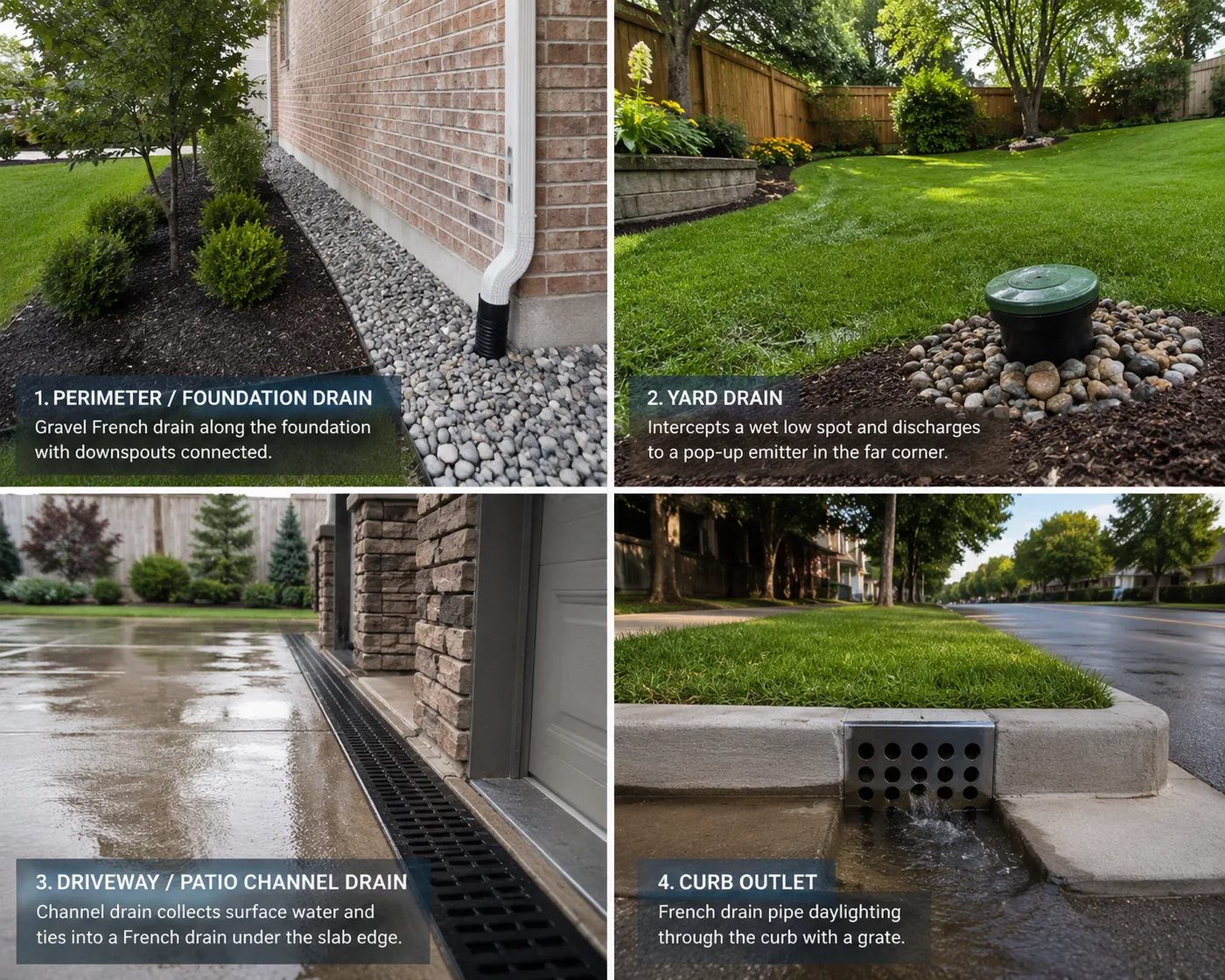
San Bernardino drainage problems are often easiest to understand when you separate the source of the water from the place where it finally collects. The sections below can help you decide what to inspect before planning a trench or repair.
Standing water that lingers
Ponding that remains well after rainfall often means the surface has no effective exit or the soil is saturated below grade.
A muddy strip beside the house
Repeated saturation along one side of a foundation can point to roof runoff, negative grading, irrigation or subsurface movement.
Erosion trails and exposed roots
Fast surface flow leaves channels, sediment and displaced mulch. A buried French drain may be part of the fix, but surface collection should also be considered.
A drainage outlet that barely flows
A French drain that stays wet while its outlet remains slow may have sediment, roots, a crushed section or insufficient fall.
Wet retaining-wall zones
Moisture appearing at the base of a slope or wall can indicate subsurface water moving downhill and may justify an interceptor drain.
When to Get a Site-Specific Drainage Assessment
If water repeatedly reaches a foundation, remains for days after rain, erodes a slope, or backs up from an existing drain, an on-site assessment can determine whether the fix is a French drain, catch basin, solid pipe, grading correction or a combination.